


What are we teaching our children to do with screens?
I grew up with screens. Video games, television and the early internet were already part of everyday life when I was a child, but I do not remember screen time being quite the parenting question it has become today. We played games, watched cartoons and spent time online, without having to think too much about how many minutes we had spent looking at a screen.
Today, screens are everywhere, and children use them for much more than entertainment. They are part of school, communication, creativity, learning and social life, as well as gaming and watching videos. So while questions about sleep, physical activity and how much time children spend on devices are important, I think there is another question worth asking alongside them: what are children actually doing with those screens?
When should children start using screens?
There is actually a period where the recommendations are much less ambiguous. For babies and very young children, major health organisations are strongly in favour of keeping screen exposure to a minimum. The World Health Organization recommends no sedentary screen time for children under 2, and no screen time at all for infants under 1. The American Academy of Pediatrics similarly recommends avoiding screen media before 18 months, apart from video chatting, and recommends that any introduction between 18 and 24 months should be limited, high-quality and accompanied by an adult.
The reasons are fairly straightforward. During these early years, children need a lot of movement, interaction with other people, play and hands-on exploration, and there is little evidence that screen use provides benefits that cannot be obtained through those experiences. This does not mean that a child watching a few minutes of a video has suddenly crossed a dangerous line, nor that parents should feel guilty about every exception. The recommendations are about what is best to prioritise during a period of particularly rapid development.
As children get older, however, the picture becomes less clear-cut. The recommendations generally move towards limits rather than complete avoidance, and the question gradually becomes less about whether a screen exists at all and more about how it fits into a child’s life.
That is where the idea of “screen time” becomes complicated, because an hour of screen use can describe very different experiences.
Not all screen time is the same
A child might spend an hour watching an endless stream of short videos, another might watch a documentary about dinosaurs, while another spends that hour trying to understand why the character they created in a video game refuses to jump. From the outside, all three are simply “screen time”, but the activity, the level of attention and what the child is actually doing can be very different.
This does not mean that some screen activities are automatically good and others automatically bad. A documentary is not suddenly beneficial just because it is educational, and a video game is not necessarily harmful because it is a game. The child’s age, the content, the context and what the activity is replacing all matter.
There is also a difference between consuming something and actively doing something. Watching one short video after another requires very little beyond deciding whether to keep watching. Learning how to draw from a tutorial, researching something a child is curious about or creating something of their own requires more decisions, attention and effort.
Video games make this particularly interesting. Some encourage exploration, problem-solving and experimentation, while others are built around short matches, progression, unlocks and constant rewards. Both are simply described as “playing video games”, but they can reinforce very different behaviours. This does not mean we need to decide which screens are good or bad. It simply means that the number of minutes alone does not tell us the whole story.
What happens when we add rewards?
This becomes even more interesting when rewards enter the picture. Rewards are already everywhere in children’s lives. Games use points, levels and unlocks, schools use praise and prizes, and adults are surrounded by loyalty programmes, bonuses and apps that turn progress into achievements.
Rewards can be useful, but they can also interact with motivation in ways that are not always obvious. In a 1999 meta-analysis of 128 studies, Deci, Koestner and Ryan examined how extrinsic rewards affect intrinsic motivation. Their findings suggested that, under certain conditions, giving someone an external reward for an activity they already find intrinsically interesting can reduce their subsequent intrinsic motivation for that activity, particularly once the reward is removed.
This does not mean that rewards are bad, or that children should never receive rewards for activities they enjoy. The effects depend on the type of reward and how it is presented. But it does give us an interesting question to consider as parents: what are we actually trying to motivate?
If a child already loves reading, drawing, building things or learning about dinosaurs, do we necessarily need to attach a reward to those activities? There may be more value in protecting that curiosity than in turning every educational activity into a rewardable task.
What should we reward?
This is one of the reasons we prefer to think about rewards primarily in relation to responsibilities and contributions to family life.
Children do not necessarily need points to discover that they enjoy reading or drawing. They may not need a reward to encourage them to spend an afternoon learning about something they are fascinated by. But they may need encouragement to put their clothes in the laundry, tidy their room, help set the table or follow their morning routine.
These responsibilities are part of growing up, and they naturally change as children become more capable. A five-year-old and a twelve-year-old should not have exactly the same expectations. The goal is not to create a fixed list of chores, but to gradually give children more responsibility and help them see their own progress.
This is where a reward system can be useful without turning family life into a transaction. Instead of attaching a specific reward to every individual task, children can accumulate points for their efforts and have some choice over what they eventually use those points for. The reward becomes an outcome of their effort rather than the reason they are expected to enjoy everything they do.
And that reward can still be screen time. If a child enjoys playing Roblox or a favourite video game, there is nothing wrong with making some extra time to play one possible reward. They might instead choose to stay up later to watch a movie with the family, save their points for something bigger or choose another activity everyone can enjoy. The important part is that screen time is one option rather than the default answer to every reward.
What about learning and creating on a screen?
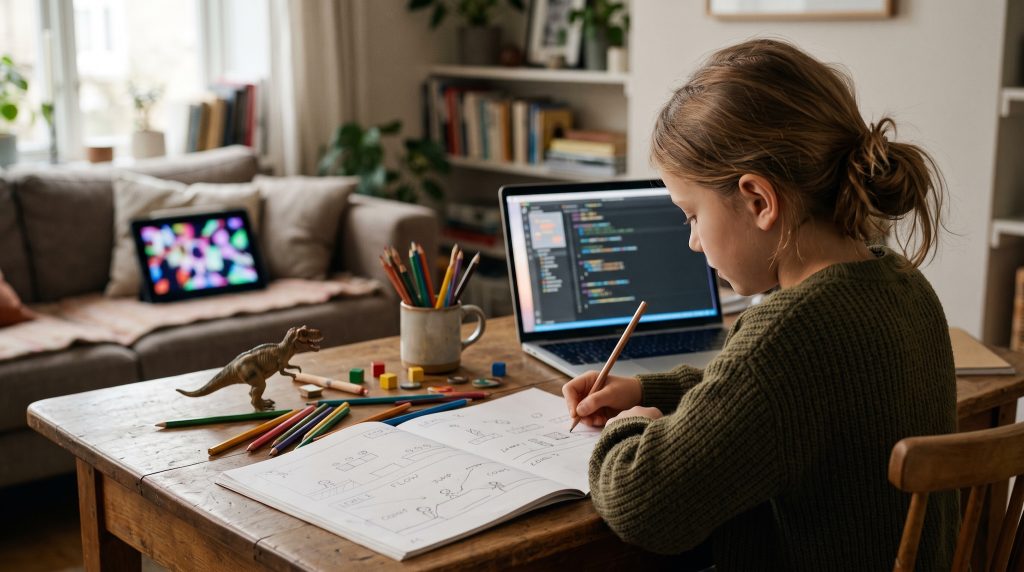
This distinction also matters when children use screens to learn or create. If a child wants to spend an afternoon learning how to code, researching sharks, making a video or building a small game, simply counting the minutes spent on the device does not tell us very much about what they are actually doing.
We have experienced this ourselves at home. One of the children has been using AI with us to build a small video game. He comes up with ideas, we discuss how the game should work, try things, break things, figure out why they do not work and gradually improve the result.
Technically, this is screen time, but it is also a creative project, a problem-solving exercise and an opportunity to learn how software works. That does not mean it needs to be unlimited or that it is automatically better than playing a game or watching a movie. It simply means that putting all of these activities into the same category because they happen on a screen is not particularly useful.
The question is not only how much screen time a child gets. It is also what they are doing with it.
Where routines fit in
This way of thinking about responsibility is actually one of the reasons we started building Groowble. At home, we realised that many of the difficult conversations around everyday tasks were not really about the tasks themselves. They were about having to remind children what needed to happen next, with every reminder potentially turning into another small negotiation.
The morning is a good example. Getting dressed, having breakfast, brushing teeth, preparing a school bag and getting out of the door are all fairly simple things, but when every step requires an adult to remind a child what comes next, the whole process becomes tiring for everyone. Turning those actions into a clear routine gives children something they can follow themselves and gradually manage more independently.
The same idea applies after school, whether that means putting clothes in the laundry, putting belongings away, doing homework or preparing for the evening. The responsibilities can evolve with age, but the underlying idea remains the same: children gradually learn to take ownership of things that are part of everyday family life.
If you are looking for ideas, we put together a guide to age-appropriate tasks for children from 4 to 14, with examples that can evolve as children become more independent.
So how much screen time is too much?
There probably is not one number that works for every child and every family. Age matters, as do sleep, physical activity, the type of content, the context in which the screen is being used and what that activity is replacing.
That does not mean limits are unnecessary. Children still need help learning when to put devices away, and adults still have an important role in setting boundaries around sleep, physical activity and other parts of family life. But alongside asking how long a child has spent on a screen, it may be worth asking a few other questions: What are they doing? Are they consuming, learning, creating or interacting? Are they making choices about what they do, or simply following whatever comes next? And what behaviours are we actually reinforcing?
Screens are going to be part of our children’s lives. Rather than treating them as something that can only be controlled by counting minutes, we can also help children learn that the same device can be used to consume, play, learn, create and communicate.
At Groowble, we think about rewards in much the same way. The goal is not to make children earn every enjoyable thing they do, nor to turn family life into a giant points system. It is to make effort and progress more visible, give children some ownership over what they work towards and help them gradually become more independent. Our approach to rules and rewards that everyone in the family understands comes from the same idea.
Maybe the more useful question is therefore not only “How much screen time is too much?”, but also:
What are we teaching our children to do with their screens?