


What tasks to assign to a child, from 4 to 14 years old?
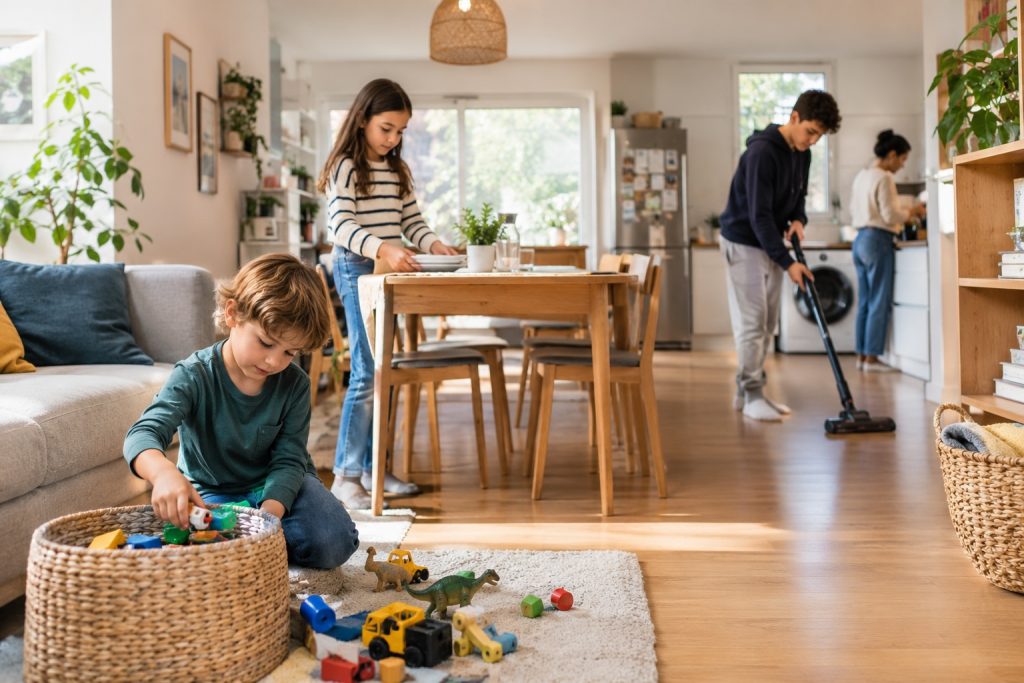
“But what can he do at his age?”
This is often the first question we ask ourselves when we start wanting to give our children responsibilities. At 4 years old, we obviously won’t ask them to empty the dishwasher by themselves. And at 13, “put away your toys” is likely no longer sufficient to cover their responsibilities at home.
So, what tasks to assign to a child according to their age? And how many points to give them?
Here is our task chart by age, from 4 to 14 years old, with concrete examples and the recommended points in Groowble.
Of course, each child is different. Some will be able to complete a task at 6 years old while another will still need help at 8 years old. So take these ages as guidelines, not as rules.
The task table by age, in summary
| Age | Examples of tasks | Points |
|---|---|---|
| 4 to 5 years | Pick up toys, make the bed, get dressed, brush teeth | 5 to 15 |
| 6 to 7 years | Clean the room, clear the table, read for 20 minutes | 5 to 15 |
| 8 to 9 years | Empty the dishwasher, shower alone, put away laundry | 5 to 15 |
| 10 to 11 years | Morning and evening routines, clean the bathroom, vacuum | 10 to 15 |
| 12 to 14 years | Do laundry, prepare a meal, clean the bathroom | 10 to 25 |
This chart is a starting point. The idea is to choose tasks suitable for your child’s autonomy, then gradually increase the responsibilities.
From 4 to 5 years: starting with small habits
At this age, the goal is not to involve your child in the big Saturday morning clean-up.
We start rather with the small things he can learn to do on his own, or with a little help.
| Task | Points |
|---|---|
| Put away toys | 5 |
| Put on pajamas and put dirty laundry in the basket | 5 |
| Make the bed | 15 |
| Brush teeth | 10 |
| Get dressed alone | 10 |
| Put away shoes | 10 |
| Set the table with an adult | 5 |
| Clean up after the meal | 5 |
At this age, a task must remain very simple and very concrete.
“Clean your room” may seem obvious to us, but for a 4-year-old child, it’s a huge and quite vague mission.
“Put your cars in the box” is much easier to understand.
From 6 to 7 years: doing more and more things alone
At around 6 or 7 years old, one can begin to gradually remove the “mom or dad must check behind” mode.
Making your bed, getting dressed, tidying up your things, or clearing the table become real little responsibilities.
| Task | Points |
|---|---|
| Make your bed | 15 |
| Get dressed by yourself | 10 |
| Brush your teeth | 10 |
| Tidy your room | 10 |
| Clear the table | 10 |
| Put away your shoes and belongings | 10 |
| Set the table | 5 |
| Read for 20 minutes | 15 |
| Put away your toys | 5 |
It is also a good age to start grouping several small tasks into a routine.
A routine is not just one big task
In Groowble, a routine can consist of several steps that the child checks off as they go along.
For example, a morning routine can include:
- get up
- make your bed
- get dressed
- have breakfast
- brush your teeth
- get ready for school
Instead of having six separate tasks, the child simply sees what is left to do in their routine.
It is particularly convenient in the morning when everyone is in a hurry and you don’t want to keep repeating “Did you get dressed?”, “Did you make your bed?”, “Did you have your breakfast?” every three minutes.
From 8 to 9 years old: starting to really help at home
From the age of 8, one can gradually transition from personal tasks to tasks that contribute to the functioning of the whole family.
| Task | Points |
|---|---|
| Make your bed | 15 |
| Tidy your room | 10 |
| Clear the table | 10 |
| Load or unload the dishwasher | 15 |
| Shower by yourself | 15 |
| Read for 20 minutes | 15 |
| Put away your laundry | 10 |
| Set the table | 5 |
| Tidy the living room items | 5 |
| Take care of a pet with supervision | 10 |
The dishwasher regularly comes up in the tasks used on Groowble. It’s a good transition between “I tidy up my things” and “I take care of a small part of the house.”
And if the family has a dog or a cat, pets are another great classic. Feeding the pet, walking the dog, or picking up after it are tasks that parents add themselves in the app.
From 10 to 11 years old: more autonomy
At this age, one can start to assign tasks that require several steps or a bit more organization.
| Task | Points |
|---|---|
| Morning routine | 15 |
| Evening routine | 15 |
| Tidy up the room | 10 |
| Clear and tidy up after the meal | 10 |
| Load or unload the dishwasher | 15 |
| Put away laundry | 10 |
| Clean the bathroom | 15 |
| Vacuum | 15 |
| Read for 20 minutes | 15 |
| Take care of the family pet | 10 |
The evening routine is particularly interesting at this age.
It can gather all those little things that you have probably already asked 400 times:
- putting clothes in the laundry
- tidying up the room
- preparing things for the next day
- finishing homework
- preparing the school bag
- brushing teeth
- getting ready for bed
Each step can be checked off as you go in Groowble.
The child sees what has been done, what remains to be done, and can complete their routine without you having to play project manager every evening.
From 12 to 14 years: moving on to real responsibilities
From the age of 12, tasks may start to resemble those that an adult will have to manage later.
No need to ask your teenager to do a complete cleaning of the house overnight. The idea is rather to gradually give them the responsibility for certain things.
| Task | Points |
|---|---|
| Morning routine | 15 |
| Evening routine | 15 |
| Clean up your room | 10 |
| Empty or fill the dishwasher | 15 |
| Do a laundry | 20 |
| Fold and put away your laundry | 15 |
| Clean the bathroom | 15 |
| Vacuum | 15 |
| Prepare a simple meal | 20 |
| Take care of the family pet | 10 |
| Help prepare the family meal | 25 |
At this age, the most interesting thing is often to move from “do this task when I ask you to” to “this task is your responsibility”.
For example, emptying the dishwasher can become his evening mission. Taking care of the dog can become his daily responsibility.
At first, points can help establish the habit. Once the task has become automatic, nothing prevents you from removing the points and moving on to a new responsibility.
The tasks that families really use in Groowble
We also looked at what is actually happening in Groowble, rather than simply making a theoretical list of chores.
Over the last four months, the morning routine ranks at the top of the tasks that continue to be validated over time. The evening routine comes in just behind.
We then find the great classics: clear the table, tidy up one’s room, brush one’s teeth, make one’s bed, and the after-school routine.
Routines are particularly interesting because they group several small actions together. They allow for transforming a series of daily reminders into a single mission that the child can follow step by step.
Parents do not limit themselves to the catalog. They also create their own tasks, particularly around animals, laundry, bedtime, or small helping hands at home.
It’s quite logical in the end: each family has its own “you could still…”.
Printable task board or app?
A printed task board can be a very good way to start.
We hang it on the fridge, we check off the tasks, and everyone sees what’s left to do. Simple, visible, effective.
The problem arises when habits change.
A new task, a different reward, a child growing up, a morning routine to modify… The chart sometimes ends up becoming just one more thing to manage.
With an application, the list can evolve with the family. One can add a new task, modify the points, or create a routine with several steps without having to redo the entire table.
Paper is therefore very good to start with. The interest in digital becomes apparent especially when the system needs to evolve with your child.
How many points to give to each task?
There is no magic scale. A task that takes a few seconds every day probably shouldn’t earn as much as a task that requires a real half-hour of work.
To begin, you can start with something very simple:
5 points for a small daily task.
10 points for a common task that requires a bit of effort.
15 points for a more important task or a complete routine.
20 points or more for an occasional task that really requires time or investment.
The important thing is mainly to look at the system as a whole.
If your child earns 5 points per day but the cheapest reward costs 500 points, they may have to wait a very, very long time before they can enjoy it.
On the contrary, if he can get everything he wants after two small tasks, the points quickly lose their interest.
The right system is one where the child easily understands:
I make an effort → I earn points → I get closer to a reward.
To keep the system motivating, try to make the first reward accessible fairly quickly. Three to five validated tasks can be a good first goal: the child quickly sees the link between their efforts and what they can achieve.
So, where to start?
No need to create a long list on the first day.
Start with a few well-chosen tasks: a small personal task, a task for the home, and possibly a morning or evening routine.
See how your child reacts. If everything goes well, gradually add new responsibilities.
The goal is not to pay your child for everything they do. The points are mainly a boost to transform a task that still requires reminders into a habit that they eventually do naturally.
And that’s also why routines are interesting: instead of asking your child to remember ten different things, you simply give them a small list to follow.
The task board on the fridge can be a good start. An app simply allows you to continue evolving it with your family.
Feel free to read our other blog articles that cover topics such as preparing for the new school year or managing sibling rivalry.
For questions regarding the use of our Groowble application, you can consult our FAQ.