


Free printable chore charts for kids: templates by age
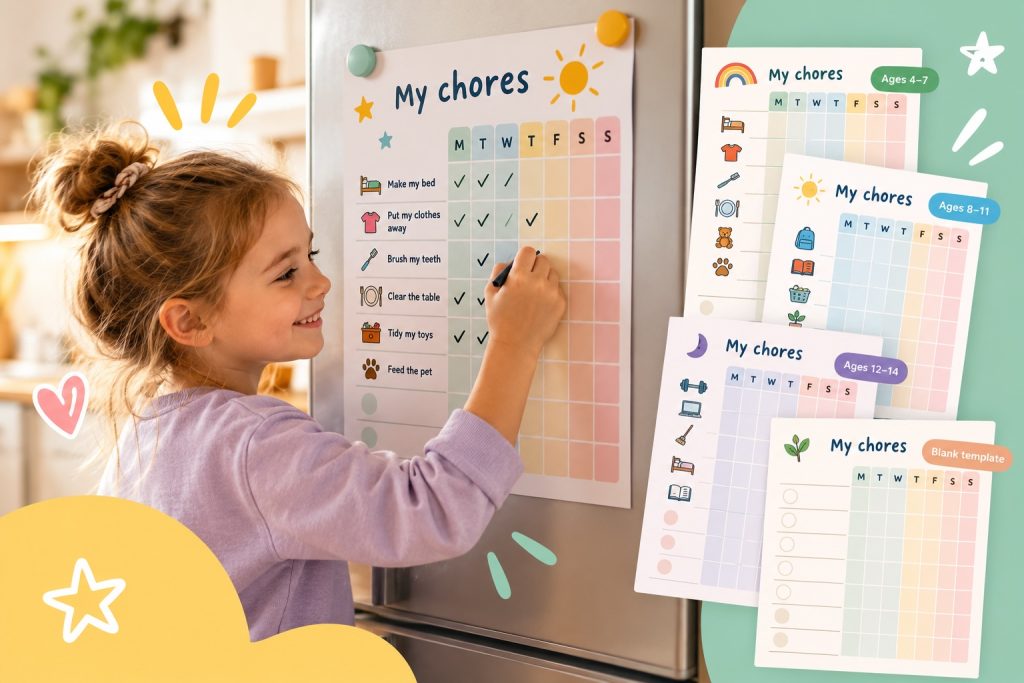
“Clean your room!” “Okey, okeyyyyy, I’m doing it!” Ten minutes later, nothing has changed. We ask again, then a third time, until we eventually do it ourselves because, frankly, it’s quicker. I think we all know those little moments in family life when we wish things would just get done without having to ask fifteen times.
But perhaps our children simply need a little help learning how to organise themselves. A chore chart can be a good place to start. It makes responsibilities visible, gives younger children something to refer to and encourages them to become more independent, one step at a time. All without turning every stray sock in the living room into a family negotiation.
To help you get started, we’ve put together four free printable chore charts, designed for children aged 4 to 14. No registration, no app to install, just a PDF and a printer.
Our free printable chore charts
The PDF contains four A4 templates, so you can choose the one that best suits your child’s age and needs.
- Ages 4–7: First everyday responsibilities, with illustrations for children who aren’t reading yet.
- Ages 8–11: Tasks that encourage independence, alongside a step-by-step morning routine.
- Ages 12–14: Greater responsibility and an evening routine to help children prepare for the following day.
- Blank template: Eight empty rows to create your own chart, whatever your child’s age.
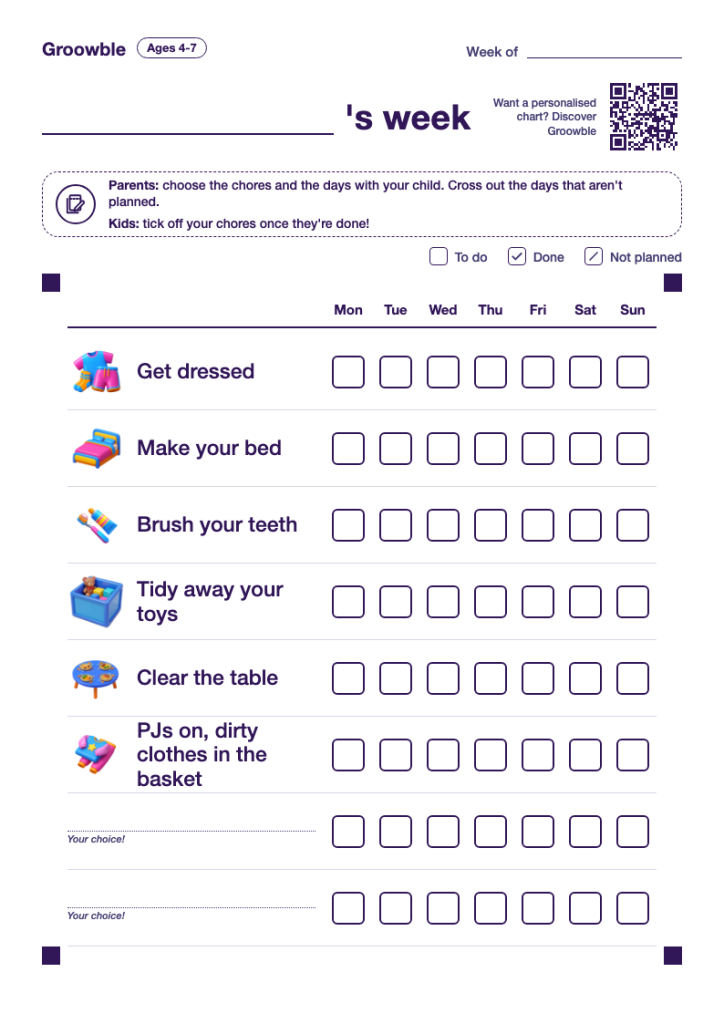
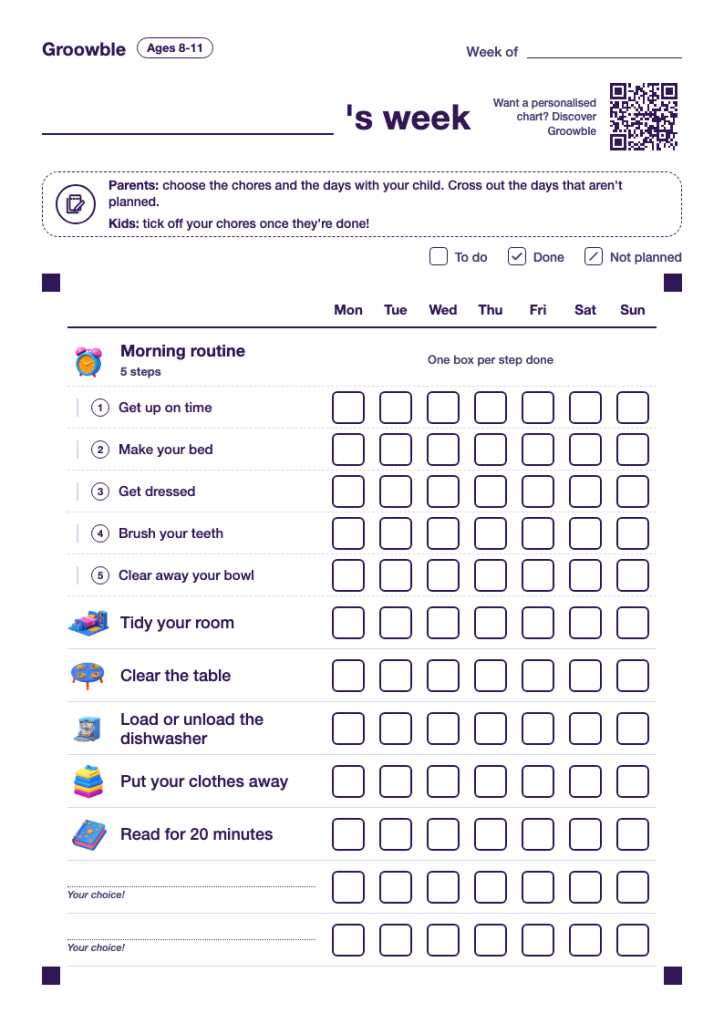
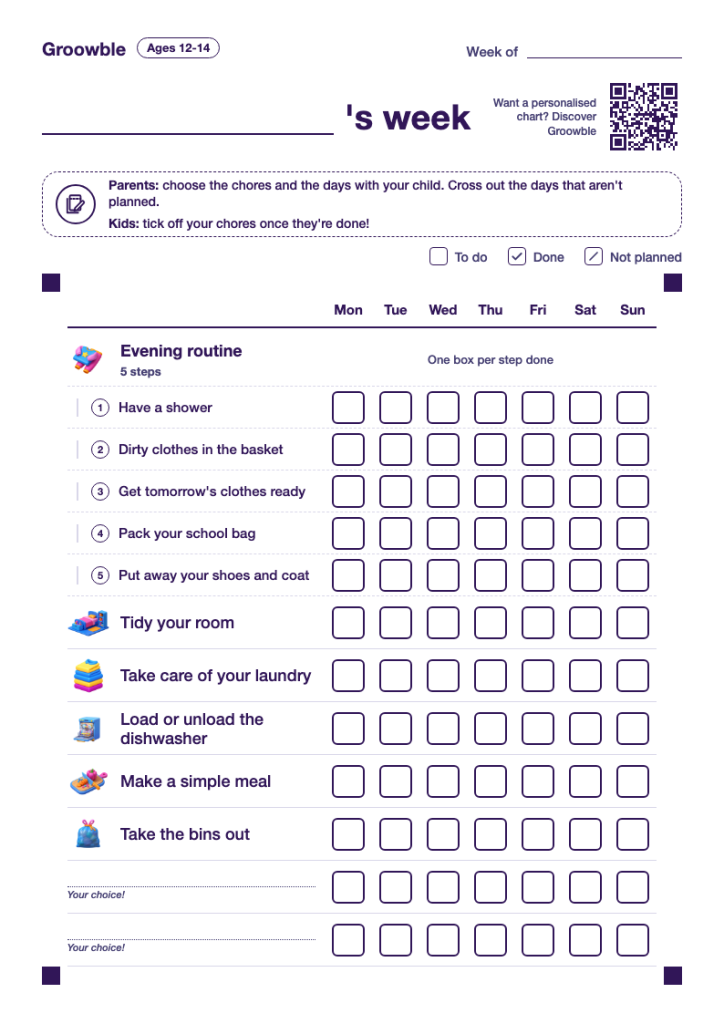
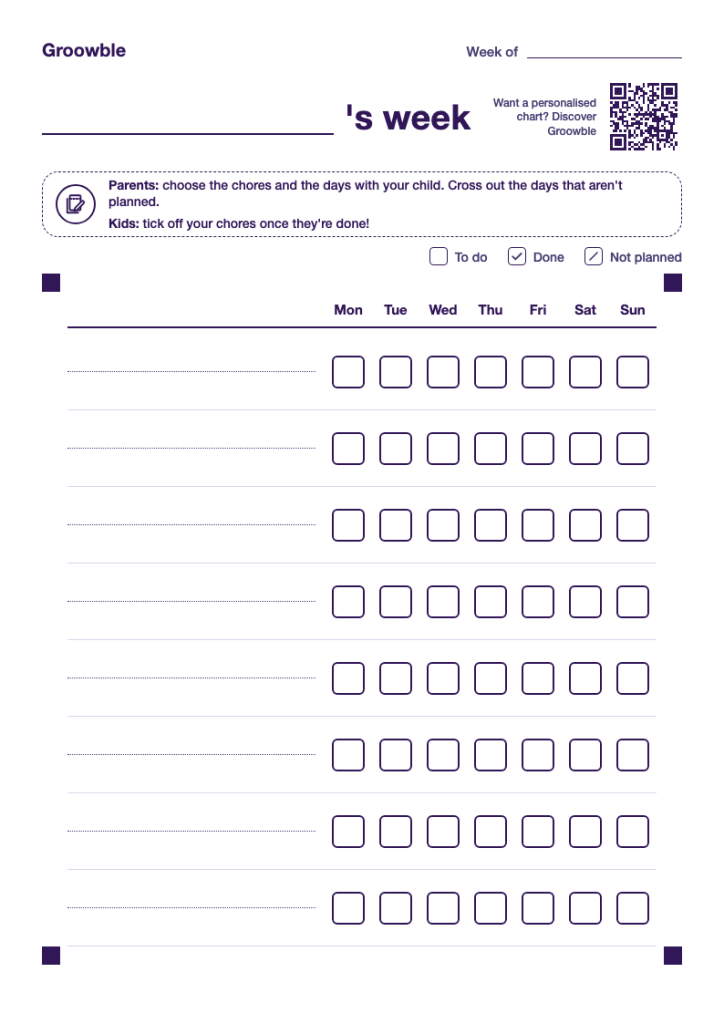
Each template covers all seven days of the week. The age-specific charts include six suggested tasks and two blank rows for responsibilities that are specific to your family. Simply decide together which days each task needs to be done, cross out the days when it isn’t scheduled and let your child tick the boxes as they go.
Here’s a little trick that might save you from getting through a printer cartridge every month: slip the chart into a clear plastic sleeve and use a wipe-clean pen. On Sunday evening, wipe it clean and start again!
Not sure which responsibilities are suitable for your child? We’ve written a whole article about age-appropriate chores for children aged 4 to 14, with examples based on their age and growing independence.
How do you stop the chore chart from becoming just another fridge decoration?
Let’s be realistic. The first few days are usually brilliant. You print out a lovely chart, the children discover all those little boxes to tick and everyone’s enthusiastic. You start thinking you’ve finally found the answer to those endless daily reminders. Two weeks later, the chart is still on the fridge, but it’s mostly become part of the decoration.
That doesn’t necessarily mean the idea was a bad one. Like any new habit, it takes a little time and a few adjustments before it finds its place in everyday family life.
Start with two or three chores, not eight
When you’re putting together a chore chart, it’s easy to get carried away. Between making beds, putting clothes away, tidying toys, picking up shoes and clearing the table, you could fill every row without even trying! But for a child who’s new to the idea, it’s better to start with two or three simple, clearly defined responsibilities.
I’d much rather see a child get into the habit of clearing their plate and putting their shoes away than have a chart full of boxes that eventually discourages everyone. Once those first habits have become part of their routine, you can gradually introduce new ones. The aim isn’t to do as much as possible, but to help children discover what they’re capable of doing for themselves.
Create the chart together
A chart created entirely by parents can easily feel like just another list of instructions. But when children help put it together, they’re more likely to feel that it’s theirs. You could, for example, offer two responsibilities and let them choose which one they’d prefer: setting the table or clearing it after dinner?
Of course, that doesn’t mean children get to decide everything. Parents are still there to set boundaries and establish everyone’s responsibilities. But giving children a say, even in small decisions, helps move away from simply following instructions towards learning to cooperate. That’s also why we’ve included blank rows in each of our templates.
Celebrate progress rather than counting empty boxes
There will inevitably be days when things don’t get done. A rushed morning, an evening when everyone’s exhausted or a week when routines fall by the wayside. And that’s not a disaster. A chore chart isn’t a school report, and it certainly shouldn’t become a way of keeping track of mistakes.
What I find helpful is taking a few minutes at the end of the week to look at what went well together. Did your child remember to pack their school bag without being reminded? That’s progress worth recognising, even if their bedroom still looks like a disaster zone. And if a particular task consistently causes problems, perhaps it’s too complicated, not clearly defined or simply not quite right for them yet.
A chore chart should help children become more independent, not create another source of arguments at home. If you’re looking for more ideas, we’ve also shared five ways to encourage children to help around the house without losing your sanity.
What if we kept the paper chart, with a little help from technology?
Personally, I like the idea of having a chore chart on the fridge. It’s visible, even the youngest children can use it, and nobody needs to get their phone out to see what still needs doing. Children can tick off their own tasks, and there’s something satisfying about watching those little boxes fill up.
But when you’re managing several children, changing responsibilities and perhaps a points or rewards system, keeping track of everything can quickly become another job for parents. That’s one of the reasons we introduced personalised printable weekly charts in Groowble.
The idea is simple: each child gets a printed chart with their own tasks. They continue ticking the boxes on paper and, at the end of the week, a parent can scan the QR code on the sheet to open the reporting screen in the app and record which tasks have been completed. Once approved, the corresponding points are awarded, without having to keep track of everything yourself.
This feature is available with Groowble Premium, but the four printable charts in this article are completely free and work independently of the app.
And if a good old-fashioned chart on the fridge is all your family needs, that’s great too! What matters isn’t the tool you use, but the little habits you’re helping your children build.
Frequently asked questions about chore charts for kids
Children can start using a chore chart from around age 3 or 4, with simple responsibilities suited to their abilities. Illustrated charts are particularly useful for younger children who can’t read yet. At this age, two or three small tasks are enough to introduce the idea.
For younger children, two or three chores are generally a good starting point. You can gradually add more depending on their age, independence and established habits. It’s better to focus on achievable, clearly defined responsibilities than to try to fill every box.
No, there’s no need to reward every single task. Contributing to family life is also part of learning responsibility and independence. Some families use points or rewards to encourage new habits, while others prefer praise and the satisfaction of a job well done. What matters is recognising effort without turning every responsibility into a negotiation. You can read more in our article about creating family rules and rewards.
You can download all four free PDF templates from this article: a blank chore chart and three age-specific charts for children aged 4–7, 8–11 and 12–14. They’re designed for A4 printing and require no registration or app installation.
Simply place the printed sheet inside a clear plastic sleeve and use a wipe-clean pen to tick off completed tasks. At the end of the week, wipe away the marks and start again. If your child’s responsibilities change, you can always print a fresh copy.
Absolutely! We recommend giving each child their own chart, with responsibilities suited to their age and abilities. This allows everyone to progress at their own pace without turning chores into a competition between siblings. The blank template also makes it easy to create a personalised chart for each child.